
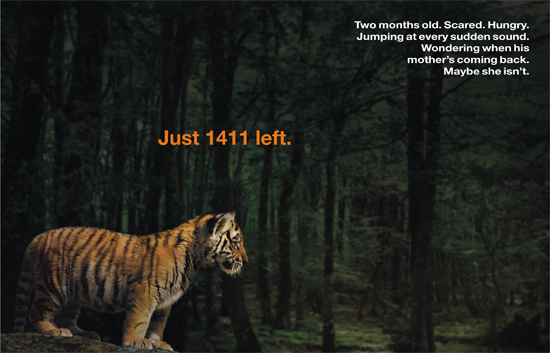
 Our national animal is fighting for its life.
 From around 40,000 at the turn of the last century, there are just 1411 tigers left in India.
If we don’t act now, we could lose this part of our heritage forever.
Speak up, blog, share the concern, stay informed… Every little bit helps.
Aircel has partnered with WWF-India to help save our tigers. Explore the site to know how you can help.
Watch this space for updates from Stripey, the tiger cub.
Saturday, February 27, 2010


Every now and then we come across news reporting Poaching of Tigers, Arrests of Poachers and siezing skins and other body parts of the Tiger.. The census of 2007 made it very clear that poaching still is done on a large scale in the most protected forests of India.. This may be our last chance to Save the Last Surviving Royal Bengal Tigers in our Country.. The final figures of the census should not only be taken seriously but as a WARNING.. !!!!
It is never too late to start.. The result of the census came as a Shock to most in our Country.. With only 1411(The figure of 2007) Tigers left, It is high time when steps for Tiger Conservation be taken up more seriously..
I came across a news article from Reuters where the Indian Conservationists say that its too late to Save The Tiger now.. There is the video showing what different conservationists have to say about the last living Tigers in India.. Click Here to See The Video..

But the Tigers themselves have not lost hope.. There has been growth in the Tiger numbers in the last month.. On May 16, A Tigress in Pench Tiger Reserve gave birth to four cubs.. Five days later another Tigress gave birth to three cubs.. On May 25 another Tigress in Pench had a litter of three cubs.. Two more Tigresses are expected to litter in the coming days.. Official figures say that there are 22 cubs ( aged 15 days - 2 years old) in the Park.. There are a few Tigresses in Bandhavgarh National Park who are also expected to litter soon.. The Banbie Female in Bandhavgarh gave birth to cubs a few days back.. The Churbehra Queen is also expected soon.. When the Tigers have not lost hope.. Why should we.. Long Live the Tiger.. !!!!

The Photos of Banbei Tigress and her Cubs were taken at Bandhavgarh National Park by Mr. Kaustubh Rishi..
The Elephant Show has also been stopped in Pench Tiger Reserve to provide security to the Cubs and their Mothers.. The Elephants are being used for protecting Tigers.. Four camps have also been set up in the Park.. 30 Tiger Protection Force Personnel, 17 ex-servicemen and over 300 daily wagers are maintaining security of the Reserve..
Nobody gets to live life backward. Look ahead, that is where your future lies. -- Ann Landers
* I Thank Mr. Kaustubh Rishi for providing me the Photos of the Tigress and her Cubs.
It is never too late to start.. The result of the census came as a Shock to most in our Country.. With only 1411(The figure of 2007) Tigers left, It is high time when steps for Tiger Conservation be taken up more seriously..
I came across a news article from Reuters where the Indian Conservationists say that its too late to Save The Tiger now.. There is the video showing what different conservationists have to say about the last living Tigers in India.. Click Here to See The Video..

But the Tigers themselves have not lost hope.. There has been growth in the Tiger numbers in the last month.. On May 16, A Tigress in Pench Tiger Reserve gave birth to four cubs.. Five days later another Tigress gave birth to three cubs.. On May 25 another Tigress in Pench had a litter of three cubs.. Two more Tigresses are expected to litter in the coming days.. Official figures say that there are 22 cubs ( aged 15 days - 2 years old) in the Park.. There are a few Tigresses in Bandhavgarh National Park who are also expected to litter soon.. The Banbie Female in Bandhavgarh gave birth to cubs a few days back.. The Churbehra Queen is also expected soon.. When the Tigers have not lost hope.. Why should we.. Long Live the Tiger.. !!!!

The Photos of Banbei Tigress and her Cubs were taken at Bandhavgarh National Park by Mr. Kaustubh Rishi..
The Elephant Show has also been stopped in Pench Tiger Reserve to provide security to the Cubs and their Mothers.. The Elephants are being used for protecting Tigers.. Four camps have also been set up in the Park.. 30 Tiger Protection Force Personnel, 17 ex-servicemen and over 300 daily wagers are maintaining security of the Reserve..
Nobody gets to live life backward. Look ahead, that is where your future lies. -- Ann Landers
* I Thank Mr. Kaustubh Rishi for providing me the Photos of the Tigress and her Cubs.
Tuesday, February 23, 2010
Panna, One of the five Tiger Reserves in Madhya Pradesh, was declared a Tiger Reserve in 1994 is nestled in the Vidhya Hills of Bundelkhand region. Merely an hour away from one of the most favorite destination of foreign tourists, Khajuraho, Panna has just pugmarks to offer. Whatever may be the official figures, The State’s Chief Conservator of Forests, Mr. H.S. Pabla, could also not get a glimpse of the National Animal.
(As per the Hindustan Times, 21st Feb, 2009 “Two days after the state’s Chief Conservator of Forests, H.S. Pabla, was not able to sight a tiger in the 540 sq km reserve, he told HT on Saturday that he was not adverse to the idea of relocating even a tiger. "If required we will even relocate a tiger to Panna," he said.”)

After the success of relocating tigers in Sariska, now its Panna’s turn. Tender forms calling bidders for filming and photography rights of the translocation of two tigresses from Bandhavgarh, Kanha/Pench to Panna have been called by the Field Director Panna Tiger Reserve.
But would it turn out to be a Success in Madhya Pradesh.. ?? I personally don’t think that this would work in M.P. How can we trust the same staff which was present when all the wild cats in Panna disappeared?
Relocating tigers may be answer to the ever declining population of tigers in the reserves. But this situation could have been avoided only if the officials would have worked when Dr Radhu Chandawat first alarmed the officials about the missing tigers in Panna long time back.
Why do we have to Relocate Tigers, when we can Save them.
Were the Panna officials not aware of the poaching done inside the restricted area? If not, why are they posted there?
What were they doing after the first tiger went missing?
What happened to the Tigers that were in Panna in the last census? What is the surety that illegal killing will not be done now?
Who will be held responsible if the new tigers that are being relocated are poached?
-
-
-
-
For now, the relocation is to take place sometime in the last week of February. And all I can do is to pray that it turns out to be a success.
"LONG LIVE THE TIGER"
(As per the Hindustan Times, 21st Feb, 2009 “Two days after the state’s Chief Conservator of Forests, H.S. Pabla, was not able to sight a tiger in the 540 sq km reserve, he told HT on Saturday that he was not adverse to the idea of relocating even a tiger. "If required we will even relocate a tiger to Panna," he said.”)

After the success of relocating tigers in Sariska, now its Panna’s turn. Tender forms calling bidders for filming and photography rights of the translocation of two tigresses from Bandhavgarh, Kanha/Pench to Panna have been called by the Field Director Panna Tiger Reserve.
But would it turn out to be a Success in Madhya Pradesh.. ?? I personally don’t think that this would work in M.P. How can we trust the same staff which was present when all the wild cats in Panna disappeared?
Relocating tigers may be answer to the ever declining population of tigers in the reserves. But this situation could have been avoided only if the officials would have worked when Dr Radhu Chandawat first alarmed the officials about the missing tigers in Panna long time back.
Why do we have to Relocate Tigers, when we can Save them.
Were the Panna officials not aware of the poaching done inside the restricted area? If not, why are they posted there?
What were they doing after the first tiger went missing?
What happened to the Tigers that were in Panna in the last census? What is the surety that illegal killing will not be done now?
Who will be held responsible if the new tigers that are being relocated are poached?
-
-
-
-
For now, the relocation is to take place sometime in the last week of February. And all I can do is to pray that it turns out to be a success.
"LONG LIVE THE TIGER"
 The tiger (Panthera tigris) is a member of the Felidae family; the largest of the four "big cats" in the genus Panthera.Native to much of eastern and southern Asia, the tiger is an apex predator and an obligate carnivore. Reaching up to 3.3 meters (11 ft) in total length and weighing up to 300 kilograms (660 pounds), the larger tiger subspecies are comparable in size to the biggest extinct Fields.
Highly adaptable, tigers range from the Siberian taiga, to open grasslands, to tropical mangrove.
Tigers appear on many flags and coats of arms, as mascots for sporting teams, and as the national animal of several Asian nations, including India. swamps. They are territorial and generally solitary animals, often requiring large contiguous areas of habitat that support their prey demands. This, coupled with the fact that they are endemic to some of the more densely populated places on earth, has caused significant conflicts with humans.
Sunday, February 21, 2010
In the past, the tiger's range was widespread in Asia, from the Caucasus and the Caspian sea to Siberia and Indonesia. During the 19Th century, these cats completely vanished from western Asia, and became restricted to isolated pockets in the remaining parts of their range. Today, their range is fragmented, and extends from India in the west to china and southeast Asia in the east. The northern limit is close to the Amur river in south eastern Siberia. The only large island inhabited by tigers today is Sumatra.
Tiger habitats will usually include sufficient cover, proximity to water, and an abundance of prey sources.Bengal Tigers live in many types of forests, including wet;evergreen; the semi-evergreen of Assam and eastern Bengal; the mangrove forest of the Ganges Delta; the deciduous forest of Nepal, and the thorn forests of the Western Ghats. Compared to the lion, the tiger prefers denser vegetation, for which its camouflage coloring is ideally suited, and where a single predator is not at a disadvantage compared with the multiple felines in a pride. Among the big cats, only the tiger and jaguar are strong swimmers; tigers are often found bathing in ponds,lakes, and rivers. Unlike other cats, which tend to avoid water, tigers actively seek it out. During the extreme heat of the day, they often cool off in pools. Tigers are excellent swimmers and can swim up to 4 miles. This cat will also carry their dead prey across lakes.
Tiger habitats will usually include sufficient cover, proximity to water, and an abundance of prey sources.Bengal Tigers live in many types of forests, including wet;evergreen; the semi-evergreen of Assam and eastern Bengal; the mangrove forest of the Ganges Delta; the deciduous forest of Nepal, and the thorn forests of the Western Ghats. Compared to the lion, the tiger prefers denser vegetation, for which its camouflage coloring is ideally suited, and where a single predator is not at a disadvantage compared with the multiple felines in a pride. Among the big cats, only the tiger and jaguar are strong swimmers; tigers are often found bathing in ponds,lakes, and rivers. Unlike other cats, which tend to avoid water, tigers actively seek it out. During the extreme heat of the day, they often cool off in pools. Tigers are excellent swimmers and can swim up to 4 miles. This cat will also carry their dead prey across lakes.

PHYSICAL CHARACTERISTICS:
Tigers are among the most recognizable of all the cats. They typically have rusty-reddish to brown-rusty coats, a whitish medial and ventral area, a white "fringe" that surrounds the face, and stripes that vary from brown or gray to pure black. The pattern of stripes is unique to each animal, and thus could potentially be used to identify individuals, much in the same way that fingerprints are used to identify people. Like other big cats, tigers have a white spot on the backs of their ears. These spots, called ocelli, serve a social function, by communicating the animal's mental state to conspecifics in the gloom of dense forest or in tall grass.Tigers have the additional distinction of being the heaviest cats found in the wild.They also have powerfully built legs and shoulders, with the result that they, like lions, have the ability to pull down prey substantially heavier than themselves.
SUBSPECIES:
There are nine recent subspecies of tiger, two of which are extinct. The surviving subspecies, in descending order of wild population, are:
1.The Bengal tiger or the Royal Bengal tiger (Panthera tigris tigris) is the most common subspecies of tig
 er and is found primarily in India and Bangladesh.[20] It lives in varied habitats: grasslands, subtropical and tropical rainforests, scrub forests, wet and dry deciduous forests, and mangroves.
2.The Indochinese Tiger (Panthera tigris corbetti), also called Corbett's tiger, is found in Cambodia, China, Laos, Burma, Thailand, and Vietnam.
These tigers are smaller an
 d darker than Bengal tigers.Their preferred habitat is forests in mountainous or hilly regions.
Estimates of the Indochinese tiger population vary between 1,200 to 1,800, with only several hundred left in the wild. All existing populations are at extreme risk from poaching, prey depletion as a result of poaching of primary prey species such as deer and wild pigs, habitat fragmentation and inbreeding.
3.The Malayan Tiger (Panthera tigris jacksoni), exclusively found in the southern part of the Malay Peninsula, was not considered a subspecies in its own right until 2004.Recent counts showed there are 60
 0–800 tigers in the wild, making it the third largest tiger population, behind the Bengal tiger and the Indochinese tiger. The Malayan tiger is the smallest of the mainland tiger subspecies, and the second smallest living subspecies.
4.The Sumatran Tiger (Panthera tigris sumatrae) is found only on the Indonesian island of Sumatra, and is critically endangered.
it is the smallest of all living tiger subspecies, with
 adult males weighing between 100–140 kg (220–310 lb) and females 75–110 kg (170–240 lb).Their small size is an adaptation to the thick, dense forests of the island of Sumatra where they reside, as well as the smaller-sized prey.
5.The Siberian tiger (Panthera tigris altaica), also known as the Amur, Manchurian, Altaic, Korean or North China tiger, is confined to the Amur-Ussuri region of Primorsky Krai and Khabarovsk Krai in far eastern
 Siberia, where it is now protected.the Amur tiger is also noted for its thick coat, distinguished by a paler golden hue and fewer stripes.
6.The South China Tiger (Panthera tigris amoyensis), also known as the Amoy or Xiamen tiger, is the most critically endangered subspecies of tiger and is listed as one of
 the 10 most endangered animals in the world.
7.The Bali Tiger (Panthera tigris balica) was limited to the island of Bali.These tigers were hunted to extinction—the last Balinese tiger is thought to have been killed at Sumbar Kima, West Bali on 27 September 1937; this was an adult female.
8.The Javan tiger (Panthera tigris sondaica) was limited to the Indonesian island of Java. It now seems likely that this subspecies became extinct in the 1980s, as a result of hunting and habitat destruction, but the extinction of this subspecies was extremely probable from the 1950s onwards. The last confirmed specimen was sighted in 1979, but there were a few reported sightings during the 1990s.the Javan tiger was one of the smaller subspecies, approximately the same size as the Sumatran tiger.
9.Caspian Tiger (formerly Panthera tigris virgata), also known as the Persian tiger or Turanian tiger was the westernmost population of Siberian tiger, found in Iran, Iraq, Afghanistan, Turkey, Mongolia, Kazakhstan, the Caucasus, Tajikistan, Turkmenistan, and Uzbekistan until it apparently became extinct in the late 1950s, though there have been several alleged more recent sightings of the tiger.
Wednesday, February 17, 2010

Tigers are essentially solitary and territorial animals. The size of a tiger's home range mainly depends on prey abundance, and, in the case of male tigers, on access to females. The relationships between individuals can be quite complex, and it appears that there is no set "rule" that tigers follow with regards to territorial rights and infringing territories. For instance, although for the most part tigers avoid each other, both male and female tigers have been documented sharing kills. tigers seem to behave relatively amicably when sharing kills, in contrast to lions, which tend to squabble and fight. Unrelated tigers have also been observed feeding on prey together. Male tigers are generally more intolerant of other males within their territory than females are of other females. For the most part, however, territorial disputes are usually solved by displays of intimidation, rather than outright aggression. Several such incidents have been observed, in which the subordinate tiger yielded defeat by rolling onto its back, showing its belly in a submissive posture.
 rights and infringing territories. For instance, although for the most part tigers avoid each other, both male and female tigers have been documented sharing kills. tigers seem to behave relatively amicably when sharing kills, in contrast to lions, which tend to squabble and fight. Unrelated tigers have also been observed feeding on prey together. Male tigers are generally more intolerant of other males within their territory than females are of other females. For the most part, however, territorial disputes are usually solved by displays of intimidation, rather than outright aggression. Several such incidents have been observed, in which the subordinate tiger yielded defeat by rolling onto its back, showing its belly in a submissive posture.
India is home to the world's largest population of tigers in the wild.According to the world wildlife fund, of the 3,500 tigers around the world, 1,400 are found in India.A major concerted conservation effort, known as Project Tiger, has been underway since 1973, which was initially spearheaded by Indira Gandhi. The fundamental accomplishment has been the establishment of over 25 well-monitored tiger reserves in reclaimed land where human development is categorically forbidden. The program has been credited with tripling the number of wild Bengal tigers from roughly 1,200 in 1973 to over 3,500 in the 1990s. However, a tiger census carried out in 2007, whose report was published on February 12, 2008, stated that the wild tiger population in India declined by 60% to approximately 1,411.It is noted in the report that the decrease of tiger population can be attributed directly to poaching. Following the release of the report, the Indian government pledged $153 million to further fund the Project Tiger initiative, set-up a Tiger Protection Force to combat poachers, and fund the relocation of up to 200,000 villagers to minimise human-tiger interaction.Additionally, eight new tiger reserves in India are being set up.Indian officials successfully started a project to reintroduce the tigers into the Sariska Tiger Reserve.The Ranthambore National Park is often cited as a major success by Indian officials against poaching.

There is more need to save our "Indian Tigers" as they are our national animal and now they are only 1411 in number.They are the symbol of our culture and traditions.There are many visitors from inside and outside country to visit them.
so do u let our national animal die....???
do you really want to loose them.....???
save our tigers and then only we can save our nation's pride !!!!
so do u let our national animal die....???
do you really want to loose them.....???
save our tigers and then only we can save our nation's pride !!!!
Subscribe to:
Posts (Atom)
Save Wid Us.


